Set Up a Safe Low-Voltage Electronics Bench
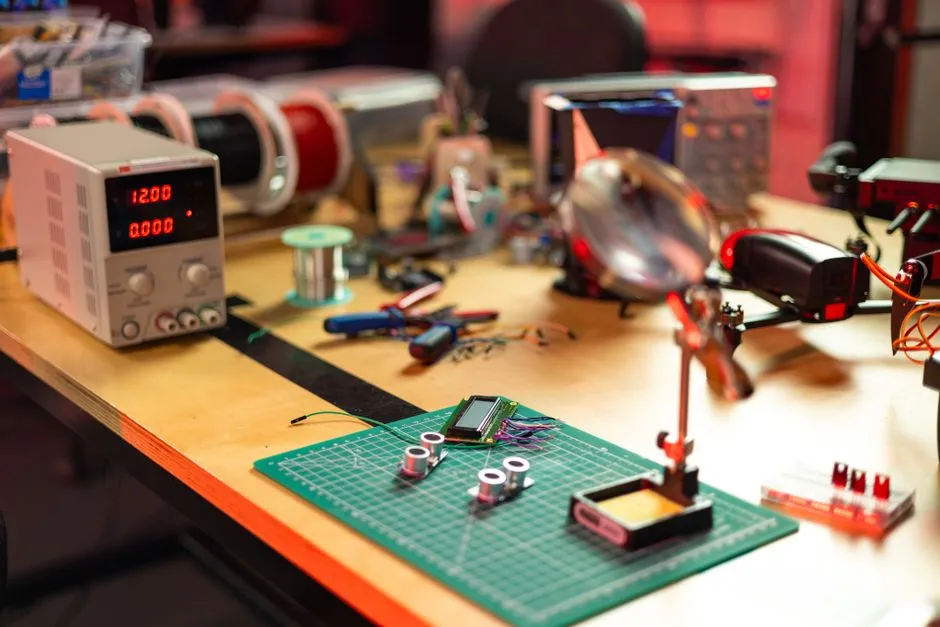
Define the bench boundary first
Use the hobby bench for isolated, current-limited low-voltage circuits whose supply, energy, polarity, and components are known. Keep mains-powered, grid-connected, microwave, CRT, medical, safety, pyrotechnic, high-voltage, and damaged battery equipment closed and unplugged for qualified service.
A small circuit can still overheat wires, vent a cell, burn skin, or damage property. “Low voltage” is a project category, not an invisibility cloak.
Choose a clear physical workspace
Use a stable, dry, nonflammable work surface with bright adjustable lighting and room to keep tools away from live conductors. Remove drinks, food, loose metal, clutter, and flammable material. Tie back hair, secure clothing, and remove conductive jewelry when contact is possible.
Keep children, pets, and bystanders away from hot tools, small parts, batteries, lead residues, and energized projects. Provide a heat-resistant iron stand and a protected cooling place for parts.
Control soldering exposure
Use local fume capture suited to the solder and flux safety data, not a desk fan that sends fumes toward another face. Read product instructions and safety data sheets. CDC/NIOSH notes that heating or soldering metal can produce lead fumes.
Do not eat, drink, or smoke at the bench. Wash hands after soldering and before touching food or the face. Store solder, flux, cleaners, and contaminated wipes in labeled containers away from household items.
Start with known power
Prefer a safety-approved isolated low-voltage supply or enclosed battery holder appropriate to the project. A bench supply should have verified voltage, polarity, and an initial current limit chosen from the circuit design and component documentation. Read current-limit setup before connecting a new build.
Add a clearly reachable power switch or disconnect. Do not use an unknown adapter merely because its plug fits; connector size does not certify voltage, polarity, isolation, regulation, or current behavior.
Organize measurement tools
Use a meter rated for the circuit and inspect case, leads, insulation, probes, jacks, and fuses before work. Return the red lead to the intended jack after a current measurement. Meter modes and jacks deserve a pre-power check every time.
Keep clips and probe accessories that prevent slips. A probe tip skating across adjacent pins can short them together and destroy parts.
Protect the circuit from the bench
Use antistatic controls when the component manufacturer calls for them, while remembering that grounding arrangements must not expose the user to hazardous energy. Keep conductive foam, loose wire ends, trimmed leads, and metal tools away from powered boards.
Place documentation, schematic, component datasheets, and a notebook within sight. Record supply settings and expected current before power-up.
Plan for heat, battery, and fire response
Use the protective equipment and extinguishing provisions appropriate to the materials and local rules. Never handle, puncture, charge, or reuse a swollen, leaking, hot, crushed, or otherwise damaged cell. Move people away and follow the battery maker and emergency authority guidance.
Battery-project safety starts with compatible protected cells, holders, chargers, and enclosures—not a loose pouch cell under a breadboard.
End every session deliberately
Deenergize, disconnect batteries where the design allows, verify irons and hot parts are safe, remove clipped leads, inspect for heat damage, and store sharp or chemical waste properly. EPA says lithium-ion batteries and devices containing them should not go in household garbage or recycling bins; use an appropriate collection channel.
A tidy bench is not decorative. It is a circuit-protection device with drawers.